Taxes
Where to find itInventory → Settings → Configuration → Taxes
Taxes define the tax rules applied to purchase and sales transactions. Each tax entry specifies the tax type, rate, and the account to which the tax amount is posted. The system supports individual taxes, compound taxes (tax-on-tax), and grouped taxes (multiple taxes bundled as one selection).
Taxes are shared by the Accounts and Inventory modules – a tax added here is also available in Accounts.
You can manage Taxes from the path: Inventory → Settings → Configuration → Taxes
List / View Taxes
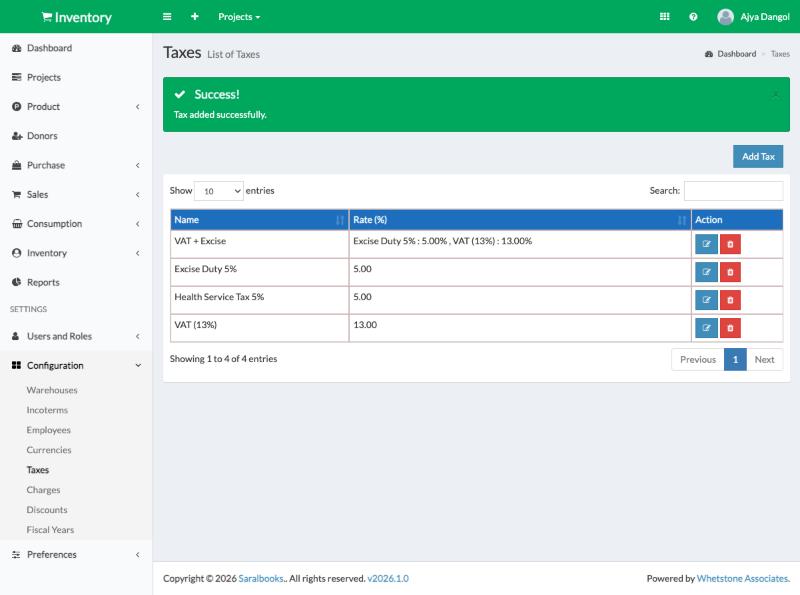
The page shows all taxes with their Name and Rate. A grouped tax shows each of its taxes and rates in the same row. From this page you can:
- View all configured taxes, including grouped and compound taxes.
- Search for a specific tax using Search.
- Sort by any column and change how many rows are shown.
1. Application Settings
- There are no Tax settings in Inventory → Settings → Preferences → Application Setting.
- Chart of Accounts is shown only when the Accounts module is active. Its list comes from Accounts → Configuration > Chart of Accounts.
- Related setting: Accounts → Settings → Automatic Voucher (On / Off). When On, Chart of Accounts becomes required.
Permissions
Set in Inventory → Settings → Users and Roles → Roles → Edit Role → Configurations → Tax. Tick the boxes the role needs, then click Update.
| Permission | What the user can do |
|---|---|
| View | See the Taxes list |
| Create | See the Add Tax button and add a tax |
| Edit | See the Edit (pencil) button and change a tax |
| Delete | See the red Delete button and delete a tax that is not used |
| Full Access | Ticks View, Create, Edit and Delete together |
2. Fields
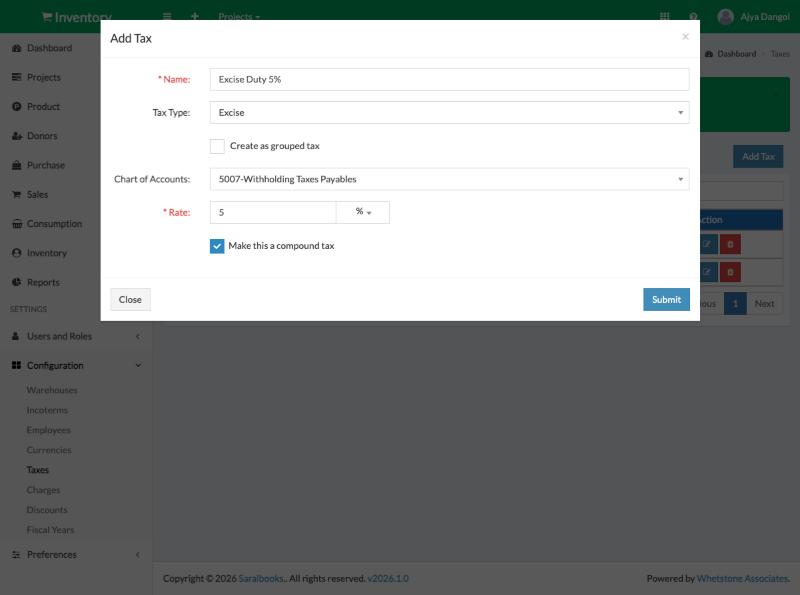
When adding or editing a Tax, the following fields are available.
| Field Name | Description | Required | Remarks |
|---|---|---|---|
| Name | The name of the tax (e.g., VAT 13%, Excise Duty 5%). | Yes | • Must be unique. |
| Tax Type | The category of the tax. | No | • Options: VAT, Excise, Health Service Tax, Education Service Tax, SDF. |
| Chart of Accounts | The account to which the tax amount is posted. | No* | • Shown only when the Accounts module is active. • *Required when Automatic Voucher is On (Accounts → Settings), because automatic vouchers post the tax to this account. • Dropdown populated from Configuration > Chart of Accounts. |
| Rate | The tax rate. | Yes | • Choose % (e.g., 13 for 13%) or Amt for a fixed amount. • Cannot be negative. |
| Make this a compound tax | Marks this tax as a compound tax (tax calculated on top of another tax). | No | • Tick box. When ticked, this tax is calculated on the amount after the preceding tax has been applied. |
| Create as grouped tax | Marks this tax as a group of individual taxes bundled together. | No | • Tick box. When ticked, the other fields are hidden and Associate Taxes is shown. See Grouped Tax below. |
| Associate Taxes (grouped tax only) | The individual taxes included in this group. | Conditional | • Shows all individual taxes with a tick box and their rate. • Drag the rows to set the order in which they apply. • At least one tax must be ticked. |
Grouped Tax
A Grouped Tax bundles multiple individual taxes into a single selectable tax entry. This simplifies transaction entry when several taxes are commonly applied together.
When Create as grouped tax is ticked:
- Tax Type, Chart of Accounts, Rate and Make this a compound tax are hidden.
- The Associate Taxes table is shown with all individual taxes.
- Tick the taxes to include and drag the rows into the order in which they are applied.
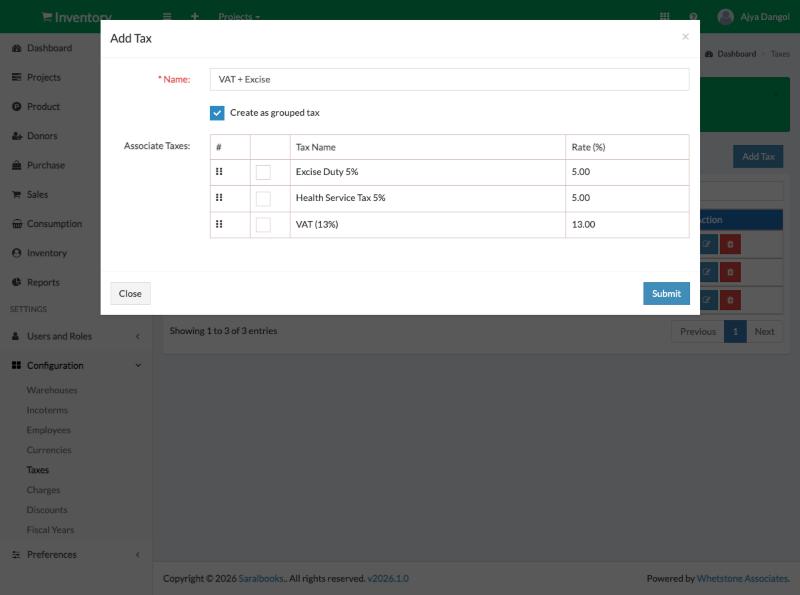
- A Grouped Tax cannot contain another Grouped Tax. Only individual or compound taxes can be included in a group.
Compound Tax
A Compound Tax is calculated on the amount after the preceding tax has already been applied (tax-on-tax). For example, if a product costs Rs. 1,000, a 13% VAT is applied first (Rs. 130), and then a 5% compound excise is calculated on Rs. 1,130 (Rs. 56.50), not on the original Rs. 1,000.
3. Create
- Go to Inventory → Settings → Configuration → Taxes.
- Click Add Tax.
- Enter the Name and select the Tax Type.
- Select the account from the Chart of Accounts dropdown (shown only when the Accounts module is active).
- Enter the Rate and choose % or Amt.
- If this is a compound tax, tick Make this a compound tax.
- If this is a grouped tax, tick Create as grouped tax, then tick and order the Associate Taxes.
- Click Submit.
Messages you may see
| When | Message |
|---|---|
| Name is empty | The name field is required. |
| Rate is empty | The rate field is required. |
| Name already used | The name has already been taken. |
| Grouped tax with no tax ticked | Please select at least one associate tax. |
4. Edit
- Go to Inventory → Settings → Configuration → Taxes.
- Locate the tax to edit.
- Click the Edit (pencil) icon – the form opens as Edit Tax.
- Modify the fields you need.
- Click Update.
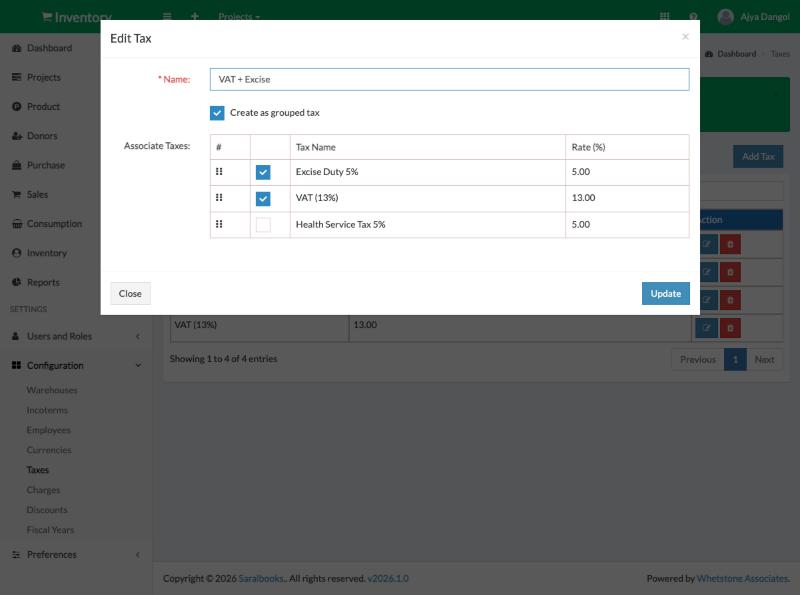
- When editing a grouped tax, the tax itself and other grouped taxes are not listed in Associate Taxes. The selected taxes are shown first, in their saved order.
5. Delete
- Go to Inventory → Settings → Configuration → Taxes.
- Find the tax you want to remove.
- Click the red Delete button.
- Confirm by clicking OK.
- A Tax cannot be deleted if it has been used in any transaction (Purchase Order, Bill, Invoice, etc.) or if it is included in a Grouped Tax. The message is: “Tax failed to be deleted. It has been already used.”
6. Upload
- Not available. Taxes are added one at a time with Add Tax.
7. Notes
- Taxes are shared by Accounts and Inventory.
- Tax Type and Chart of Accounts are optional. If Automatic Voucher is On in Accounts → Settings, select the Chart of Accounts so automatic vouchers post the tax to the right account.
- Create the individual taxes first, then the grouped taxes that use them.
- Set the order of a grouped tax carefully when it contains a compound tax – the compound tax is calculated on the amount after the taxes before it.
- NGO/INGO and Corporate: Taxes works the same in both.
- Name each tax with its rate (e.g., VAT 13%) so it is easy to pick in transactions.